How to Plan a Walking Route Across Railroad Tracks
A rail crossing needs its own place in your walking plan. Learn what to look for before making it part of a daily route.
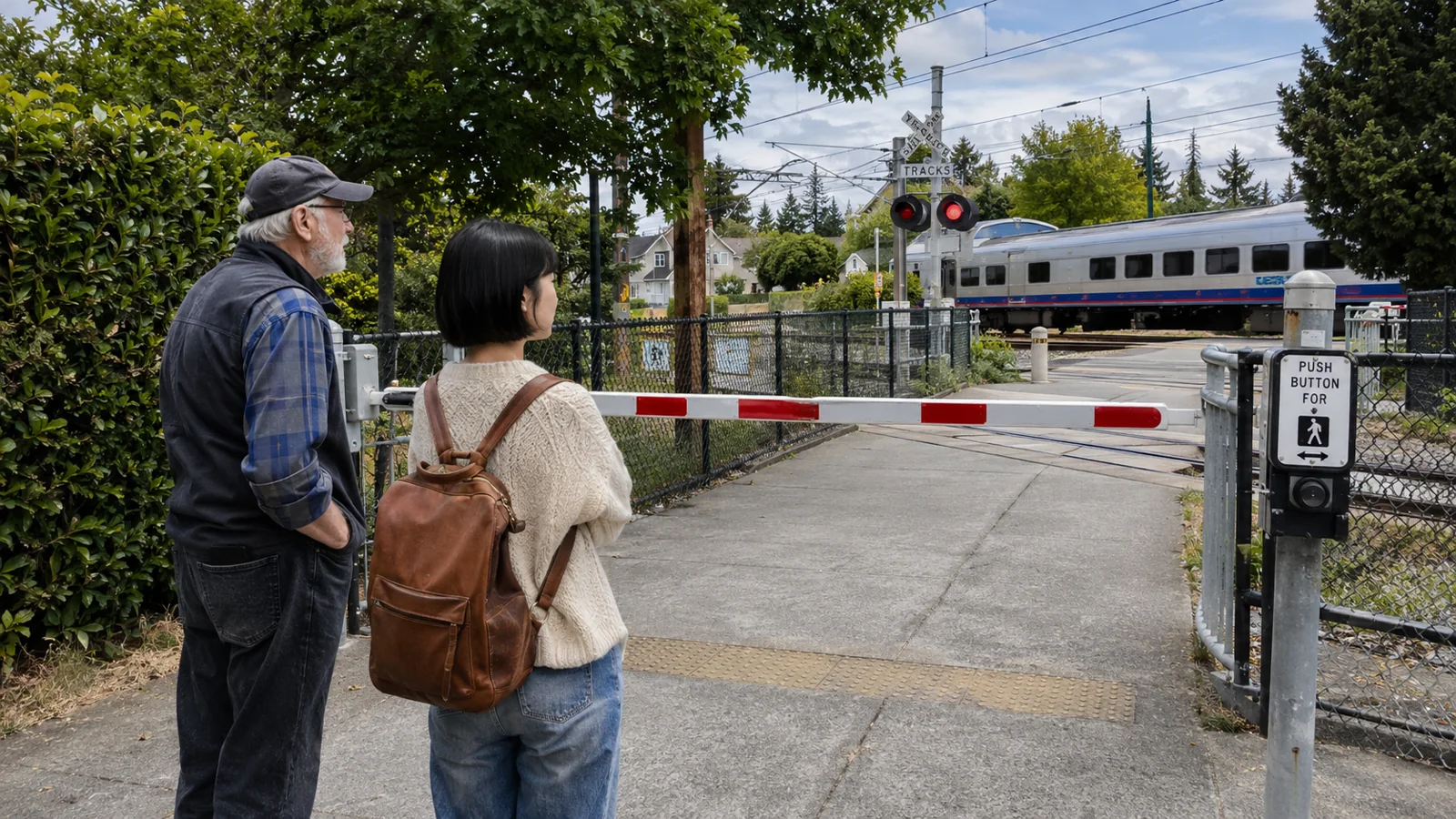
A railroad crossing can look like a small detail on a walking map. On the ground, it may be the part of your commute that determines whether the route works at all. The sidewalk might end before the tracks, a gate may close just as you arrive, or an apparently direct shortcut may lead onto railroad property.
Plan around the crossing itself, including where you wait and where the footpath continues on the other side. A route is useful only if its connections work as well as its straight sections.
Start with a designated public crossing
Operation Lifesaver’s pedestrian guidance says to cross at designated public crossings and to expect trains at any time, from either direction. Tracks are not a walking path, and railroad bridges or tunnels are not pedestrian shortcuts.
When reviewing a route, look for an established public crossing that actually accommodates the way you travel. A line on a map is not enough to establish that there is a usable sidewalk connection. If the approach is unclear, check with the relevant road authority or transit operator before depending on it.
Our guide to choosing a walking route beyond the shortest option offers a broader way to compare alternatives. Add the rail crossing to that comparison, even if it appears only once during the journey.
Look at the approach and the exit
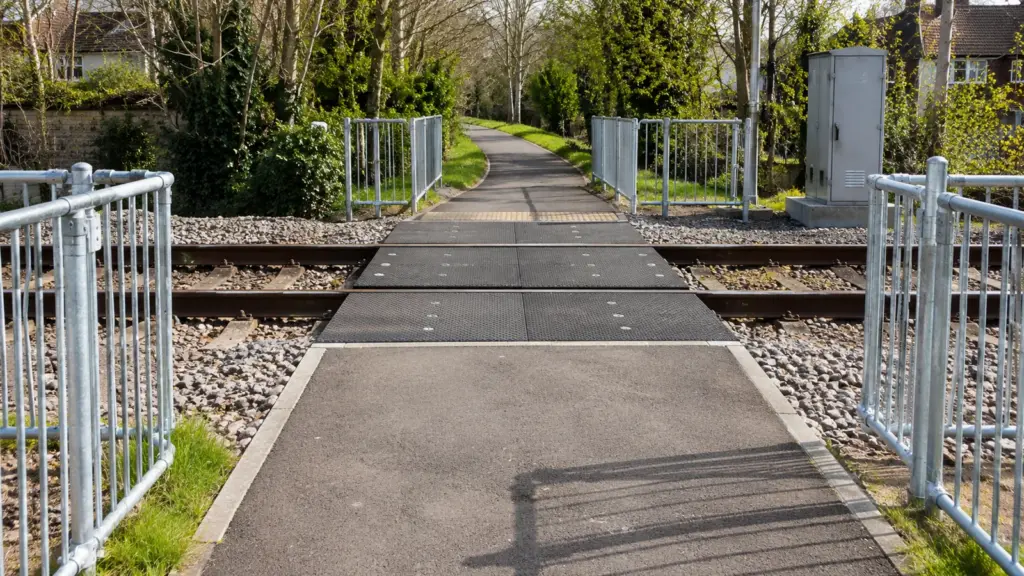
On a daytime visit from a public sidewalk, notice where a pedestrian would wait. Is the waiting area separate from the tracks and roadway? Does the path continue beyond the farthest rail? Can you complete the crossing without stopping on it?
Also consider your actual travel needs. A person walking alone, someone using a wheelchair, and a parent with a stroller may encounter different problems at the same surface. If you cannot identify a usable path across and away from the tracks, choose another route and ask the responsible authority about the crossing.
Take notes after moving to a safe location. For an access problem, useful details include the street name, the side of the crossing, and whether the difficulty is at the approach, rail gap, or exit. Do not enter the tracks to inspect or photograph a defect.
Wait for the entire warning sequence to finish
Operation Lifesaver advises waiting until flashing lights stop and gates are fully raised before crossing. A train that has just passed may conceal another train, especially where there are multiple tracks. Stay behind the designated waiting boundary; do not walk around, under, or between lowered gates.
Build waiting into your trip rather than treating it as an exceptional delay. If a missed connection would make you feel pressured to hurry, plan an earlier departure or identify another onward service. The gate sequence is not something a commuter can safely negotiate with a tighter schedule.
A crossing without active gates still needs attention. The Federal Railroad Administration’s pedestrian guidance calls for looking and listening, following crossing instructions, and crossing without stopping. The absence of flashing lights is not proof that no train is approaching.
Account for wheels and uneven surfaces
The FRA advises approaching rails at a right angle with wheels such as those on wheelchairs and strollers, because gaps can catch them. Operation Lifesaver also advises walking a bicycle across. Follow the designated crossing layout and avoid improvised movements that take you outside the public crossing.
If the layout or surface does not allow you to cross safely, use a different designated route. Do not assume you can solve an inaccessible crossing by briefly following the tracks. Our article on sidewalk obstacles and detours can help you plan the surrounding street connections.
Know how to report a crossing problem
At many crossings, a blue-and-white Emergency Notification System sign identifies the railroad’s emergency contact and the crossing’s identification number. The FRA explains how those signs help report hazards. Make a report from a safe place away from the tracks, and follow instructions from the railroad or emergency personnel.
For an ordinary route-planning question, use the relevant agency’s routine contact channel. Keep your report factual: what is obstructed, where it is, and how it affects the public path. A precise description is more useful than saying the entire crossing feels inconvenient.
Make the alternative usable before you need it
Save the location of another designated crossing or a different transport connection. Check that the alternative has a continuous walking route rather than merely another point where a road intersects the railway.
If your return trip happens after sunset, review our guide to walking home after dark as well. Lighting and opening hours along the approach can change the usefulness of an otherwise familiar route. A good rail-crossing plan includes somewhere appropriate to wait, a clear way across, and a workable option when the route is unavailable.